
第二章:文艺复兴人的书卷
读 Jerry Brotton "The Renaissance: A Very Short Introduction"所作笔记与摘录,P38-57

原书及其作者:Jerry Brotton 的 "The Renaissance: A Very Short Introduction",大主题,小开本。文艺复兴对于欧洲,是从不假思索的中世纪世界中出离的年代,它就和现代性本身一样复杂。
系列上一篇:A global Renaissance | 全球范围
Chp2 The humanist script
>p39 This chapter examines the rise of one of the most complex and controversial of all philosophical terms, Renaissance humanism, and its close relationship to one of the most important technological developments of the pre-modern world, the invention of the printing press. …… These scholars fashioned themselves ‘humanists’ and engaged in an immense undertaking to understand, translate, publish, and teach the texts of the past as a means of understanding and transforming their own present. Renaissance humanism gradually replaced the medieval scholastic tradition from which it emerged.
>p40-41 It relies on the assumption that a non-vocational study of the liberal arts makes you a more civilized person, and gives you the linguistic and rhetorical skills required to succeed in the workplace. However, there are abiding tensions built into this assumption, tensions that can be traced back to Renaissance humanism. …… Humanism marketed its skills to a governing elite that was persuaded to value the linguistic, rhetorical, and administrative expertise that a humanist education provided.
>p41 As a result, humanism concentrated its efforts on disseminating its method through the classroom and the revolutionary medium of the printing press. Humanism’s alliance with print allowed scholars to distribute standardized copies of their publications in vast numbers way beyond the reproductive possibilities of scribal manuscript production. The impact of this association was a subsequent rise in both literacy and schools, creating an unprecedented emphasis on education as a tool of socialization.
文艺复兴所兴起的人文主义,是整整一代知识分子通过重新发掘古典文学而形成的新的学术风尚,古典的材料传递全新的诠释。这种风尚认为对于修辞和逻辑的训练可以让人更文明、更能够在现实中成功(主要指从政),然后它通过在学术机构内不断自我复制和传播,说服当时的社会精英他们所看重的技能是有价值的,知识就有了销路,“教育”一举成为人类社会化成长中的重要一环。
文艺复兴以前,知识和书本基本由极少数的精英和贵族掌握,但是到了文艺复兴时期,印刷术出现了,全新的载体彻底革新了知识的传播模式和数量级。
The persuaders
>p42-43 Cicero was crucial to Petrarch and the subsequent development of humanism because he offered a new way of thinking about how the cultured individual united the philosophical and contemplative side of life with its more active and public dimension. …… This was the blueprint for Petrarch’s humanism: the unification of the philosophical quest for individual truth, and the practical ability to function effectively in society through the use of rhetoric and persuasion. To obtain the perfect balance the civilized individual needed rigorous training in the disciplines of the studia humanitatis, namely grammar, rhetoric, poetry, history, and moral philosophy.
>p43 This was a brilliant argument for giving the early humanists greater power and prestige than their scholastic predecessors had ever enjoyed. Medieval scholasticism had trained students in Latin, letter-writing, and philosophy, but its teachers and thinkers were generally subservient to the authorities (usually the church) for which they worked. Cicero’s definition of the civilized humanist, able to philosophize on humanity while also training the elite in the skills of public oratory and persuasion, gave humanism and its practitioners greater autonomy to ‘sell’ their ideas to social and political institutions.
>p43 Humanists styled themselves as orators and rhetoricians, gurus of style rather than politics. It is often a mistake to take the subject matter of humanist writing at face value. Such writings were highly formal exercises in style and rhetoric, often delighting in dialectically arguing for and against a particular topic.
Back to the drawing board
>p44-45 However, Guarino’s classroom did not necessarily produce the humane, elite citizens he promised. His education involved a gruelling immersion in grammar and rhetoric, based on diligent note-taking, rote learning of texts, oral repetition, and rhetorical imitation in a seemingly endless round of basic exercises. There was little time for more philosophical reflection on the nature of the texts under analysis, and students’ lecture notes reveal only a very basic grasp of the new ways of speaking and writing that humanists like Guarino believed were the basis of humanist education. These elementary lessons in language and rhetoric did prepare students for basic employment in legal, political, and religious positions, although this was a long way from the exalted heights promised by Guarino in his introductory lectures.
A woman’s place is in the humanist’s home
>p47 Renaissance humanism did not necessarily create new opportunities for women. It encouraged women’s education as a social adornment and an end in itself, not as a means to step out of the household and into the public sphere. Struggling male humanist teachers and students were having enough difficulty carving out their own public and professional positions. The possibility of women achieving such a public profile was clearly threatening, potentially embarrassing, and intolerable.
The printing press: a revolution in communication
>p49-50 Printing permeated every area of public and private life. Initially presses issued religious books - Bibles, breviaries, sermons, and catechisms - but gradually more secular books were introduced, like romances, travel narratives, pamphlets, broadsheets, and conduct books advising people on everything from medicine to wifely duties. ...... A culture based on communication through listening, looking, and speaking gradually changed into a culture that interacted through reading and writing. Rather than being focused on courts or churches, a literary culture began to emerge around the semi-autonomous printing press. Its agenda was set by demand and profit rather than religious orthodoxy or political ideology. Printing houses turned intellectual and cultural creativity into a collaborative venture, as printers, merchants, teachers, scribes, translators, artists, and writers all pooled their skills and resources in creating the finished product.
大生产和协作化的利益导向生产方式开始在知识领域出现。
>p50-51 Print also transformed how knowledge itself was understood and transmitted. A manuscript is a unique and unreproducible object. Print, however, with its standard format and type, introduced exact mass reproduction. This meant that two readers separated by distance could discuss and compare identical books, right down to a specific word on a particular page. With the introduction of consistent pagination, indexes, alphabetic ordering, and bibliographies (all unthinkable in manuscripts), knowledge itself was slowly repackaged. …… The printing press did not just publish written texts. Part of the revolutionary impact of print was the creation of what William Ivins has called ‘the exactly repeatable pictorial statement’. Using woodcuts and then the more sophisticated technique of copperplate engraving, printing made possible the mass diffusion of standardized images of maps, scientific tables and diagrams, architectural plans, medical drawings, cartoons, and religious images.
“标准化”彻底革新知识的传播方式,现在千里之外的人能够确信,指着同一本书的同一个页码,我们所谈论的就是完全相同的字句。这还只是文字,图表、标准化的地图,也在印刷术广泛应用之后才获得了广泛传播的可能。
The humanist press
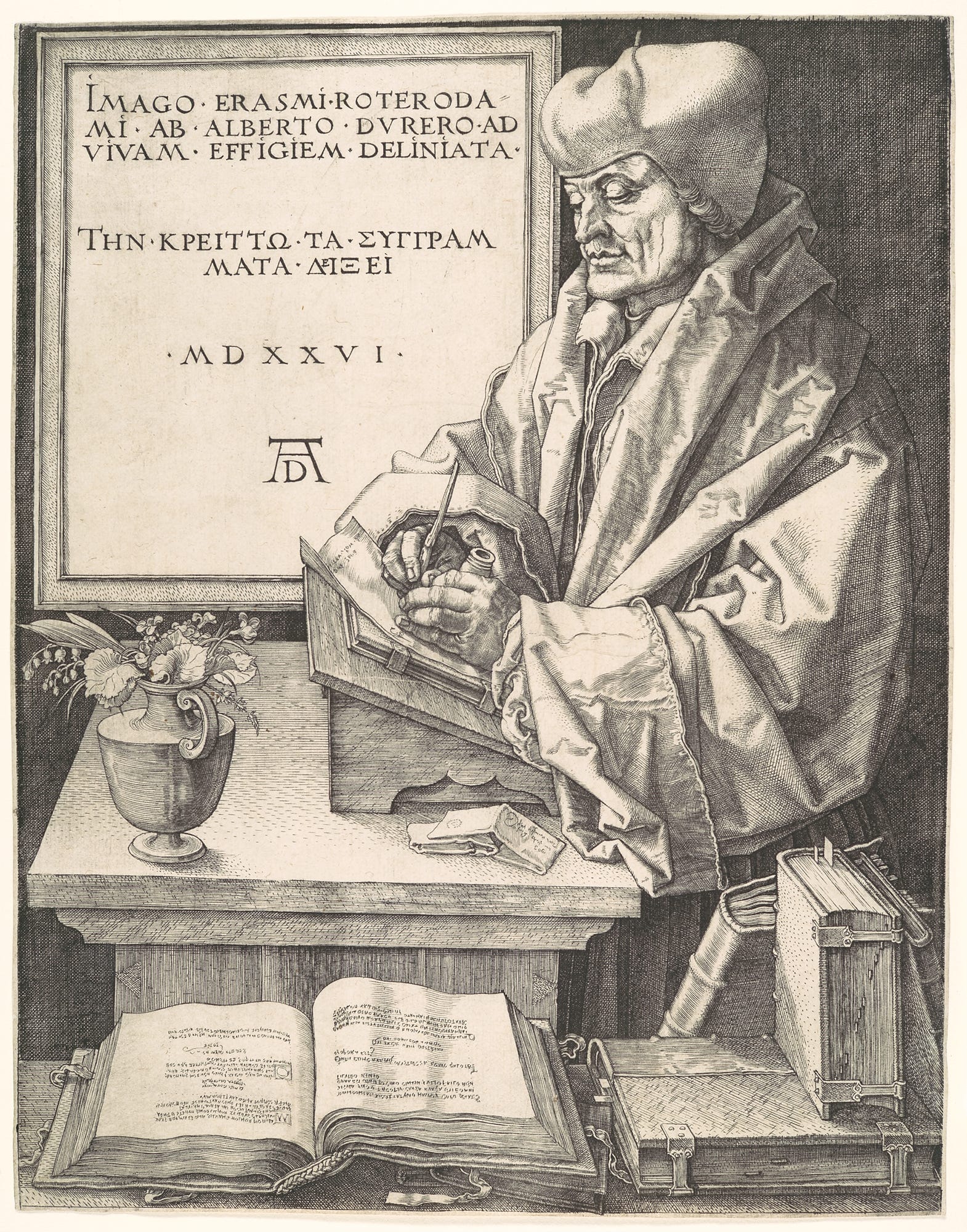
The politics of humanism
>p57 From Petrarch to More, Renaissance humanism flexibly served whoever it seemed politically expedient to follow. This is why a range of modern political philosophies have claimed that books like The Prince and Utopia justify their own claims to power and authority. Renaissance humanism continues to exercise a powerful influence upon the modern humanities, yet as this chapter has argued, humanism is not the idealized celebration of humaneness that it often claimed to be, but has a hard core of pragmatism. The legacy of Renaissance humanism is far more ambivalent than many have been led to believe, partly because its rhetoric remains so seductive.
文艺复兴的核心往往被颂扬为对人性的发现和高举,但是对于身在其中的学者而言,重点在于,那一代的人文主义者(the Renaissance Humanist)构建了一种完全不同于以往学术圈的行为模式。文艺复兴以前,也就是中世纪的知识储备和学术活动往往由教会或者王室贵胄垄断,文人受制于他们的雇主。但是文艺复兴学者主张,个人的学术研究与沉思应该与积极的社会行为相结合,不仅要在私人的哲学沉思中探索知识,而且要用雄辩的口才让权力认可你的理论与价值——他们是实干家,他们的学术活动是要指向加官进爵的,而且他们主动说服雇主来重视他们。比起遵从单一的理想追求,文艺复兴学者能够运用修辞造诣服务于任何政体的雇主。
原书信息:Brotton, Jerry, The Renaissance: A Very Short Introduction, Very Short Introductions (Oxford, 2006; online edn, Oxford Academic, 24 Sept. 2013), https://doi.org/10.1093/actrade/9780192801630.001.0001